HTS Codes vs. Schedule B Numbers: Strategic Classification Risk in Global Supply Chains
Article Summary
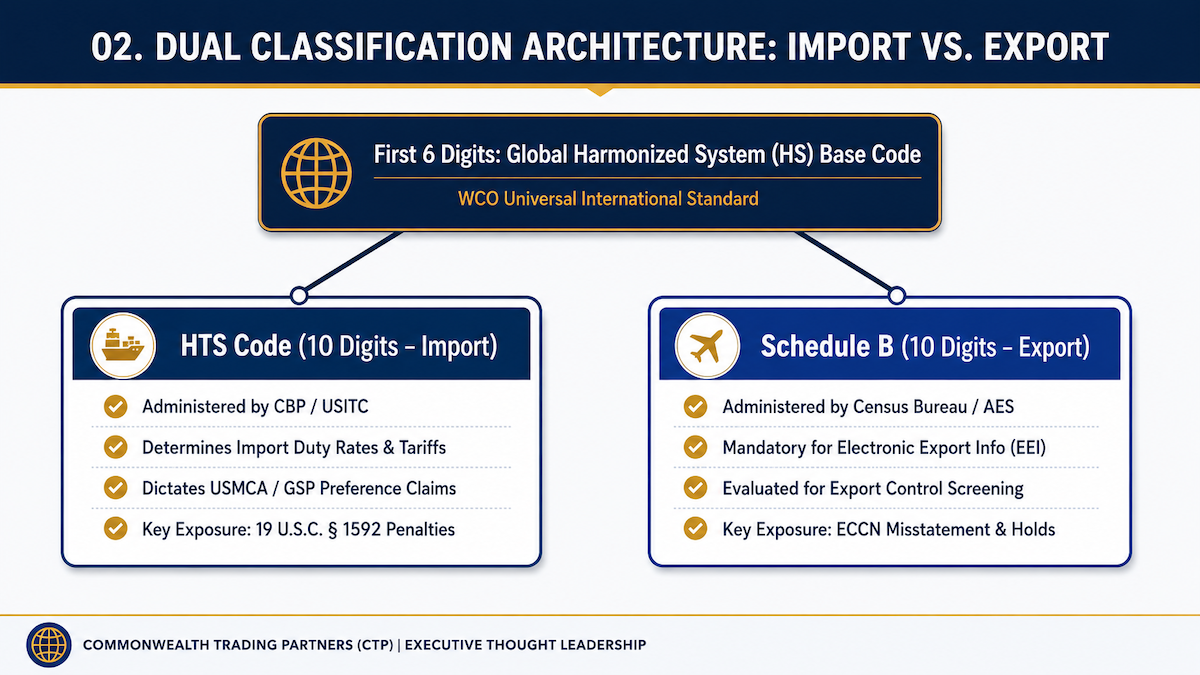
HTS codes are 10-digit numbers used to classify goods entering the United States, determining duty rates, trade preference eligibility, and anti-dumping applicability. They are administered by CBP using the U.S. International Trade Commission's tariff schedule. Schedule B numbers are 10-digit codes used to classify goods leaving the United States, primarily for trade statistics purposes, required on the Electronic Export Information filing in AES and administered by the Census Bureau. Both are built on the same 6-digit Harmonized System base — which is why they are frequently confused — but beyond those first six digits, the breakouts can differ, and using one where the other is required is itself a compliance error.
Because classification is the foundation on which duty rates, trade preference eligibility, export control flags, and Customs audit exposure all rest. A wrong HTS code can assign a higher duty rate than the product warrants — producing overpayments that compound over years. It can quietly eliminate trade preference savings the company is entitled to. It can trigger CBP penalties under 19 USC § 1592 that reach the domestic value of the merchandise for negligent violations. And on the export side, a wrong Schedule B number can misstate what is leaving the country — a material problem when the item has an ECCN or is subject to end-use controls.
The four primary financial consequences are duty overpayment from incorrect duty rate assignment that may persist for years before discovery; missed trade preference savings under programs like USMCA or GSP that require the correct HTS code to support the preference claim; Customs penalties under 19 USC § 1592 that can reach the domestic value of the merchandise for negligent violations and four times the value for fraud; and export control exposure on the export side when an incorrect Schedule B number misstates the nature of the exported item.
In some cases yes — through prior disclosures and post-entry amendments that correct the classification and claim a refund of overpaid duties. However, recovery is only possible within statutory time limits, and companies that do not periodically audit their classifications may not discover overpayments until the recovery window has closed. Duty recovery analysis should be part of any classification audit program for companies that have been using classifications without periodic review.
Freight forwarders make their best guess at classification based on limited product knowledge and time constraints — and their best guess carries no legal protection for the importer or exporter whose compliance obligations the classification determines. In-house or expert classification with documented technical rationale — covering the HS heading, subheading, and the reasoning for the 8- or 10-digit breakout — provides both accuracy and the documented defensibility that Customs audit response requires.
A misclassified HTS code isn't a paperwork problem. It's a shipment held at the border, a penalty notice from Customs, and duty overpayments you'll never recover unless you ask.
Every commercial import into the United States requires a Harmonized Tariff Schedule (HTS) code. Every export requires a Schedule B number. They're built on the same international framework (the HS system), but they serve different purposes, are administered by different agencies, and carry different consequences when they're wrong.
Most companies treat classification as a clerical task, something the freight forwarder handles. In practice, misclassification is one of the most common and most expensive compliance errors in international trade, because the code drives the duty rate, determines whether the shipment qualifies for a trade-preference program, triggers or clears export-control flags, and sits at the center of any Customs audit.
HTS (import) vs. Schedule B (export): the distinction that matters.
- HTS codes are 10-digit numbers used to classify goods entering the United States. They determine the applicable duty rate, eligibility for preferential programs (like USMCA or GSP), and anti-dumping or countervailing duties. Administered by U.S. Customs and Border Protection (CBP) using the U.S. International Trade Commission's tariff schedule.
- Schedule B numbers are 10-digit codes used to classify goods leaving the United States, primarily for trade-statistics purposes. Required on the Electronic Export Information (EEI) filing in AES. Administered by the Census Bureau.
Both are built on the same 6-digit Harmonized System (HS) base, which is why they're often confused. But beyond the first six digits, the breakouts can differ and using an HTS code where a Schedule B is required (or vice versa) is itself an error.
Where classification goes wrong and what it costs:
- Duty overpayment. The wrong HTS code can assign a higher duty rate than the product actually warrants. Companies overpay for years before discovering the error, if they discover it at all. Prior disclosures and post-entry amendments can recover some of this, but only within statutory time limits.
- Missed trade preferences. Products eligible for reduced or zero duties under USMCA, GSP, or other preferential programs don't automatically receive the benefit. The HTS code must support the claim. A misclassification can quietly eliminate savings the company is entitled to.
- Customs penalties. CBP treats repeated misclassification as negligence, or worse. Penalties under 19 USC § 1592 can reach the domestic value of the merchandise for negligent violations and four times the value for fraud.
- Export-control flags. On the export side, a wrong Schedule B number can misstate what's actually leaving the country, which matters if the item has an ECCN, is subject to end-use controls, or is destined for an embargoed country.
What to do:
- Classify in-house or with expert support. Don't default to the freight forwarder's best guess.
- Document the classification rationale, including the HS heading, subheading, and the technical reasoning for the 8- or 10-digit breakout.
- Audit your existing classifications periodically. Tariff schedules change, products evolve, and trade-preference eligibility shifts.
- If you've been overpaying duties, explore whether a prior disclosure or post-entry amendment can recover them.
The classification is the foundation. Everything downstream, including duties, preferences, compliance, audit risk, rests on it. CTP provides HTS and Schedule B classification support, tariff engineering, and duty-recovery analysis. Request a classification review →
Key Points
How do HTS codes and Schedule B numbers differ in their compliance implications, and what operational mistakes does treating them as interchangeable produce?
The HTS and Schedule B distinction is more consequential than most trade compliance programs reflect — and the operational mistakes that treating them as interchangeable produces affect duty liability, export control accuracy, and statistical reporting integrity simultaneously:
- Different administrative authority creating different correction pathways, penalty structures, and audit exposure when errors are identified in each system — HTS errors are CBP matters subject to 19 USC § 1592 penalty authority, post-entry amendment procedures, and CBP audit review; Schedule B errors are Census Bureau matters affecting AES filing accuracy and trade statistics integrity, with export control implications when the misclassified item has an ECCN or is subject to end-use controls; companies that treat HTS and Schedule B as interchangeable do not distinguish between these different administrative frameworks and cannot implement the correct remediation pathway when errors in each system are identified.
- Six-digit HS base convergence masking 8- and 10-digit divergence that produces classification errors when HTS codes are used for Schedule B filings or vice versa — The shared 6-digit Harmonized System base creates the appearance of interchangeability that produces the most common HTS/Schedule B confusion error; beyond the first six digits, HTS and Schedule B breakouts can differ in ways that make a code that is correct for import classification incorrect for export filing; using the HTS code on the EEI filing or the Schedule B number on import entry documentation is a filing error that CBP and Census Bureau audits are specifically designed to identify.
- Export control intersection making Schedule B accuracy a compliance matter beyond statistical reporting when exported items have ECCNs, are subject to end-use controls, or are destined for embargoed countries — A Schedule B error that misstates the nature of an exported item is not merely a statistical inaccuracy when the item has export control implications; a wrong Schedule B number that undercharacterizes a controlled item's technical nature can mask an export that should have triggered ECCN review, license determination, or end-use screening — converting a classification error into a potential export control violation whose consequences extend well beyond trade statistics correction.
- Trade preference program eligibility requiring HTS code precision at the 10-digit level that generic or approximated classifications cannot support — USMCA, GSP, and other preferential trade programs require HTS codes at the 10-digit level whose specific breakout is consistent with the preference program's product eligibility criteria; a classification that is approximately correct at the 6- or 8-digit level but uses the wrong 10-digit breakout may fail to support a preference claim whose eligibility depends on the specific subheading — quietly eliminating savings the company is entitled to without generating any compliance flag that the preference claim was incorrectly denied.
- Audit exposure concentration at the classification level making classification accuracy the single highest-leverage compliance investment for companies subject to CBP entry review — CBP audit programs — including Focused Assessment audits and Centers of Excellence and Expertise reviews — examine classification accuracy as a primary audit dimension; companies whose classifications have not been reviewed against current tariff schedules, whose classification rationale is not documented, or whose freight forwarder-assigned classifications have not been validated against technical product specifications face concentrated audit exposure at the compliance dimension that CBP scrutiny most directly targets.
What does accurate HTS classification require technically, and how should companies structure classification processes to produce defensible determinations rather than best-guess assignments?
HTS classification is a technical analytical exercise whose defensibility depends on documented methodology — and the gap between a freight forwarder's operational best guess and an expert classification with documented rationale is the gap between CBP audit exposure and audit protection:
- HS heading determination as the foundational classification step requiring product technical analysis against GRI interpretation rules rather than product name matching against tariff schedule descriptions — Correct HTS classification begins with General Rules of Interpretation application that determines the appropriate HS heading based on the product's essential character, material composition, and function rather than its commercial name; tariff schedule descriptions frequently do not match commercial product names, and classification based on name matching rather than GRI analysis produces heading determinations that may be commercially intuitive but technically incorrect — a distinction that CBP audit review is specifically designed to surface.
- Subheading and 10-digit breakout determination requiring technical specification review against the tariff schedule's specific breakout criteria that distinguish between product variants within the same heading — Once the correct heading is identified, subheading and 10-digit breakout determination requires evaluating the product's specific technical characteristics — material composition percentages, performance parameters, physical dimensions, processing methods — against the tariff schedule's breakout criteria that distinguish between duty rates and preference eligibility within the same heading; breakout determination based on general product category rather than specific technical specification review produces classifications that may be correct at the heading level while being incorrect at the subheading level where duty rates and preference eligibility are actually determined.
- Classification rationale documentation creating the evidentiary record that CBP audit defense requires and that supports reclassification when tariff schedules or product specifications change — Every HTS classification determination should be supported by documentation that captures the GRI analysis applied, the HS heading determination rationale, the subheading and 10-digit breakout criteria evaluated, the technical specifications compared against those criteria, and the sources consulted — including CBP rulings, Explanatory Notes, and relevant court decisions; classification records that document only the assigned HTS code without the analytical rationale cannot be defended in a CBP audit and cannot support reclassification when regulatory or product changes make the original determination obsolete.
- CBP ruling research as a classification accuracy tool that identifies binding and informational rulings for similar products whose classification conclusions provide the most authoritative guidance available outside a formal ruling request — CBP publishes binding and informational rulings on product classifications through its CROSS database whose research for similar products provides the most directly applicable classification guidance available; classification processes that do not include CBP ruling research as a standard step miss the most authoritative external validation source for classification conclusions and are more likely to produce determinations that conflict with CBP's established positions on similar products.
- Formal CBP ruling requests for high-volume, high-duty-rate, or classification-boundary products providing binding classification certainty that protects against retroactive duty assessment and penalty exposure — For products whose classification involves genuine technical ambiguity, whose duty rate differential between alternative classifications is significant, or whose trade preference eligibility depends on classification accuracy, formal CBP ruling requests provide binding classification certainty that protects against the retroactive duty assessment and penalty exposure that uncertain self-classification creates; the investment in formal ruling requests for classification-critical products typically produces returns — through duty rate certainty, preference eligibility confirmation, and audit protection — that substantially exceed the classification analysis cost.
How should companies approach duty recovery analysis for historical misclassification, and what statutory mechanisms and time limits govern the recovery opportunity?
Duty overpayment from historical misclassification represents a recoverable financial loss for many importers — but recovery requires timely action through defined statutory mechanisms whose windows close without extension:
- Post-entry amendment filing as the primary recovery mechanism for duty overpayments identified within the one-year period following entry liquidation — CBP's post-entry amendment process allows importers to correct classification errors and claim refunds of overpaid duties for entries that have been liquidated within the preceding year; post-entry amendments that correct the classification to a lower-duty code and document the technical rationale for the correct classification can recover overpaid duties within this window — making timely identification of classification errors through periodic audit programs the practical prerequisite for post-entry amendment recovery.
- Protest filing under 19 USC § 1514 as the recovery mechanism for liquidated entries within 180 days of liquidation — For entries whose liquidation has already occurred, protest filing under 19 USC § 1514 provides a 180-day window to challenge the classification and claim a refund; protests must identify the specific classification error, provide the correct HTS code with supporting technical rationale, and demonstrate that the correct classification produces a lower duty rate; protests filed outside the 180-day window are time-barred regardless of the merits of the classification argument — making the 180-day deadline the most critical time limit in duty recovery analysis.
- Prior disclosure consideration for systematic misclassification patterns that may involve penalty exposure alongside duty recovery opportunity — Companies that identify systematic misclassification patterns — the same incorrect HTS code applied across a product line over multiple years — face not only duty recovery opportunity but potential penalty exposure under 19 USC § 1592 for the pattern of misclassification; prior disclosure to CBP before the agency discovers the error can mitigate penalty exposure while the duty recovery process proceeds; companies that identify systematic misclassification should assess both the recovery opportunity and the penalty exposure simultaneously with legal counsel rather than pursuing duty recovery without evaluating whether the disclosure of the misclassification pattern creates penalty risk.
- Duty recovery financial analysis quantifying the recoverable amount across the full entry population subject to the misclassification and evaluating recovery against the cost of the amendment or protest process — Duty recovery analysis should begin with a financial assessment that estimates the total overpaid duties across the full entry population subject to the identified misclassification — across all affected product lines, all affected entry dates within the recovery window, and all applicable duty rate differentials; this financial assessment provides the basis for evaluating whether the recovery opportunity justifies the amendment or protest filing investment and for prioritizing recovery efforts when multiple misclassification patterns are identified simultaneously.
- Tariff engineering as a proactive duty reduction strategy that structures product specifications, sourcing, and processing to achieve correct classification at lower duty rates rather than recovering overpaid duties retroactively — Beyond recovering historical overpayments, classification review frequently identifies tariff engineering opportunities — product specification adjustments, sourcing structure changes, or processing modifications that achieve the same commercial outcome at a lower correct duty rate; tariff engineering that is implemented proactively through legitimate product and sourcing structure adjustments produces ongoing duty savings that retroactive recovery cannot achieve — making classification review the starting point for both historical recovery and prospective duty reduction strategy.
How should companies structure periodic classification audit programs to maintain accuracy as tariff schedules change and product lines evolve?
Classification accuracy is not a one-time achievement — it is an ongoing maintenance obligation whose lapse produces the compounding duty overpayment and audit exposure that periodic audit programs are designed to prevent:
- Tariff schedule change monitoring as a classification currency requirement ensuring that existing classifications are reviewed when HS updates, tariff schedule revisions, and trade agreement modifications affect applicable codes — The Harmonized System undergoes periodic revisions — most recently in 2022 — that reassign products between headings and subheadings in ways that can make previously correct classifications incorrect without any change to the product; tariff schedule monitoring that identifies HS revision impacts on existing classifications and triggers reclassification review for affected products maintains classification currency through regulatory change rather than discovering classification obsolescence during CBP audit.
- Product modification trigger requiring classification review when engineering changes, material substitutions, or processing modifications affect the technical characteristics that determine classification — Product evolution is the most common source of classification drift — a product whose specifications change may move between headings, subheadings, or 10-digit breakouts without the classification record being updated to reflect the modified product's correct code; compliance programs must establish product modification notification protocols that route engineering changes, material substitutions, and processing modifications through classification review before the modified product is imported or exported under the prior classification.
- New product introduction classification as a launch prerequisite requiring that import and export classifications are determined before commercial deployment — Classification review at new product introduction — before pricing, customs documentation, and trade preference claims are established around an assumed code — enables correction of classification errors before they compound across multiple entries; classification conducted after commercial deployment requires retroactive correction of duty liabilities, trade preference claims, and export filings that the incorrect classification has already generated.
- Risk-based audit sampling concentrating classification review resources on the product categories with the highest duty rate exposure, the largest import volumes, and the most significant trade preference eligibility — Periodic classification audits cannot review every classification with equal depth; risk-based sampling that concentrates audit resources on high-duty-rate products, high-volume import lines, products with trade preference claims whose eligibility depends on classification accuracy, and products at classification boundary points where tariff schedule ambiguity is greatest produces audit findings with the most significant financial and compliance implications rather than distributing audit effort uniformly across a classification population where risk is distributed unequally.
- Classification audit documentation standards requiring that audit findings, reclassification decisions, and duty recovery assessments are recorded with sufficient specificity to support CBP audit response and post-entry amendment filing — Classification audit records must document what classifications were reviewed, what technical analysis was conducted, what reclassification decisions were made and why, and what duty recovery or penalty exposure implications were identified; audit documentation that records only that a classification review was conducted without capturing the analytical findings and decisions cannot support the post-entry amendment filings, prior disclosures, or CBP audit responses that classification audit findings may require.
What does CTP's classification support, tariff engineering, and duty recovery analysis offer organizations whose classification programs need expert reinforcement?
Classification accuracy, duty recovery, and tariff engineering are technical disciplines whose combined financial return — through correct duty rates, recovered overpayments, and proactive duty reduction — typically justifies expert engagement on a stand-alone financial basis:
- Expert classification support providing the technical product analysis, GRI interpretation, CBP ruling research, and classification rationale documentation that defensible HTS and Schedule B determinations require — CTP's classification support provides the technical foundation that freight forwarder best-guess assignments cannot — including GRI-based heading determination, subheading and 10-digit breakout analysis against specific technical criteria, CBP ruling research for similar products, and classification rationale documentation whose specificity supports CBP audit defense; expert classification investment for high-volume, high-duty-rate, or classification-boundary products produces accuracy and defensibility returns that best-guess classification cannot provide.
- Duty recovery analysis identifying overpayment patterns across historical entry populations and quantifying the recoverable amount within applicable statutory windows — CTP's duty recovery analysis surveys historical entry classifications against the correct technical classification to identify overpayment patterns, quantifies the recoverable amount across the entry population within applicable amendment and protest windows, and supports the post-entry amendment and protest filings that convert identified overpayments into recovered duties; duty recovery analysis frequently identifies recovery opportunities whose financial return substantially exceeds the analysis cost — making it one of the highest-ROI compliance investments available to companies that have not recently audited their classifications.
- Tariff engineering analysis identifying legitimate product specification, sourcing structure, and processing modifications that achieve correct classification at lower duty rates — CTP's tariff engineering analysis evaluates product specifications, sourcing structures, and processing arrangements against tariff schedule classifications to identify legitimate modifications that achieve the same commercial outcome at a lower correct duty rate; tariff engineering opportunities identified through classification review produce ongoing duty savings that compound across future import volumes — generating financial returns that justify classification investment on a prospective basis independently of historical overpayment recovery.
- Periodic audit program design building the classification monitoring, product modification notification, and tariff schedule change tracking infrastructure that maintains classification accuracy over time — CTP's audit program design provides the systematic classification currency maintenance that one-time classification review cannot deliver — including audit sampling frameworks, product modification notification protocols, tariff schedule change monitoring systems, and classification documentation standards that maintain accuracy through the product evolution and regulatory change that classification drift most commonly involves.
- The classification is the foundation — CTP's classification support, tariff engineering, and duty recovery analysis address the compliance dimension whose accuracy determines duty liability, trade preference eligibility, export control accuracy, and audit exposure simultaneously; organizations that invest in classification accuracy as a foundation rather than treating it as a clerical task are building the compliance infrastructure on which every downstream trade decision — duties, preferences, compliance, audit risk — can be confidently made.