Your AI Assistant Just Made a Deemed Export. And Nobody Noticed

Article Summary
A deemed export occurs when a non-U.S. person accesses controlled technical data—even inside the United States. AI tools create new pathways for this to happen without intent: an AI assistant indexing a controlled folder, a user pasting ITAR-stamped data into a cloud-based chatbot, or a non-U.S. employee querying a tool that surfaces controlled content from a shared environment can each constitute a deemed export under ITAR or EAR regardless of whether anyone intended or noticed the disclosure.
Microsoft Copilot, when enabled across a Microsoft 365 tenant, can index and surface content from any file the user has access to—including ITAR- or EAR-controlled technical data. Cloud-based AI tools including ChatGPT and other external assistants receive pasted data that leaves the controlled environment and may be processed on infrastructure accessible to non-U.S. persons. Any AI-enabled tool in an environment where non-U.S. persons have access to controlled folders presents deemed export exposure.
Small defense subcontractors typically lack the dedicated export control teams, classified environments, and IT security budgets that large prime contractors maintain—but face the same legal obligations. A 15-person machine shop with one IT contractor and a folder of ITAR-stamped drawings received from a prime has the same deemed export compliance obligations as a major defense firm, without the resources to implement the controls that those obligations require.
Prime contractors routinely stamp drawings as ITAR as a catch-all measure—sometimes without specifying the USML category, sometimes on data that may not actually be a defense article at all. Subcontractors accept the stamp, store the file, and never independently classify it. The result is that subcontractors bear the compliance cost of controlling data that may not be controlled—and cannot distinguish genuinely controlled files from over-stamped ones without conducting their own classification analysis.
Five actions are most urgent: audit which AI tools—including third-party integrations—can reach folders containing controlled data; apply sensitivity labels, data loss prevention rules, and conditional access policies to controlled folders before enabling AI tools across the tenant; map the workforce to identify which individuals are U.S. persons and which are not; independently classify data marked ITAR without USML category specification rather than treating the stamp as definitive; and document controls and gaps because a documented compliance program materially affects enforcement outcomes if an inadvertent deemed export does occur.
Yes—materially. As the Bosch declination demonstrated, the existence of a documented compliance program—even one with gaps—significantly affects enforcement outcomes. Voluntary self-disclosure, demonstrated good-faith compliance effort, and documented controls are factors that regulators weigh in determining enforcement disposition. A company with a documented program that experienced an inadvertent deemed export is in a substantially different enforcement position than a company with no compliance documentation at all.
Somewhere right now, an engineer at a small defense subcontractor is pasting an ITAR-stamped drawing into a chatbot to speed up a quote. An AI copilot is indexing a shared folder full of controlled technical data. And nobody in the building knows that a deemed export may have just occurred.
This isn't a future problem. It's a current one and it's hitting the companies least equipped to catch it.
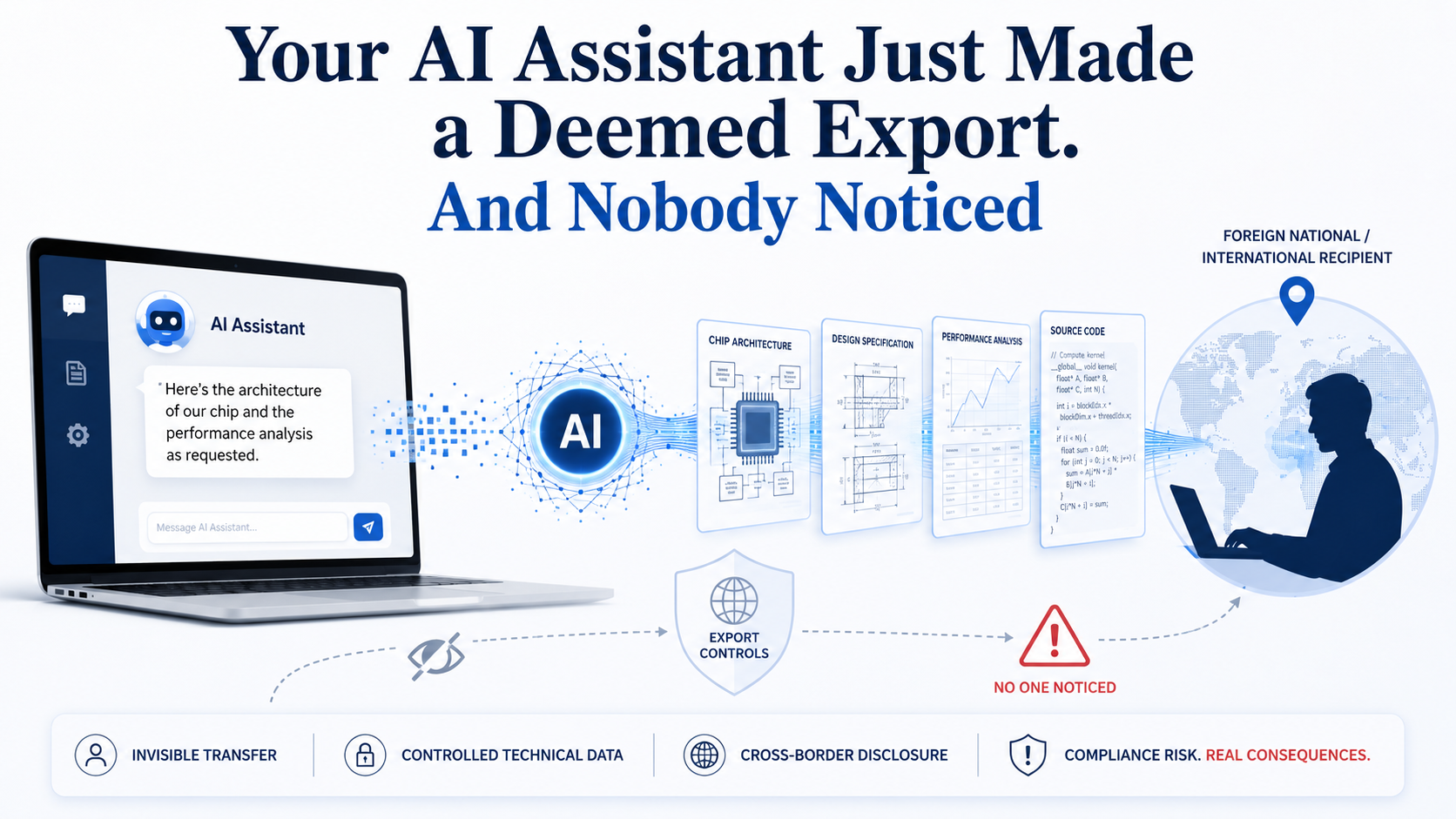
The setup is the same at hundreds of small defense manufacturers: 10 to 50 people, a Microsoft 365 environment, one IT person (or a managed service provider), and a folder of ITAR-stamped drawings received from a prime contractor. Under ITAR, a non-U.S. person accessing those files counts as an export, even inside the United States. That rule hasn't changed. What's changed is that AI tools have created entirely new pathways for that access to occur without anyone intending it or even knowing it happened.
Three ways AI tools create deemed-export exposure:
- AI assistants indexing controlled folders. Tools like Microsoft Copilot, when enabled across a tenant, can index and surface content from any file the user has access to including ITAR- or EAR-controlled technical data. If a non-U.S. employee queries Copilot and it pulls from a controlled folder, that's a potential deemed export.
- Pasting controlled data into external AI tools. When someone copies technical data into ChatGPT, Claude, or another cloud-based AI tool to draft a response, generate a summary, or speed up a quote, the data leaves the controlled environment. If the AI service processes or stores the data on infrastructure accessible to non-U.S. persons, the export-control question is live.
- Shared environments with mixed-nationality teams. Many small contractors employ or subcontract non-U.S. persons, lawful permanent residents, visa holders, or foreign-national consultants. If those individuals can access controlled data through any AI-enabled tool in the environment, the access itself can trigger a licensing requirement.
Why small defense subs are especially exposed:
The companies most at risk are the ones with the fewest resources to manage it. Large primes have dedicated export-control teams, classified environments, and IT security budgets. A 15-person machine shop with one IT contractor does not. But the legal obligation is the same.
Making matters worse, many small subs don't know whether their data is controlled. Primes routinely stamp drawings "ITAR" as a catch-all, sometimes without specifying the USML category, sometimes on data that may not actually be defense articles at all. The sub accepts the stamp, stores the file, and never independently classifies it. The result: Companies are bearing the compliance cost of controlling data that may not even be controlled and they can't distinguish the genuinely controlled files from the over-stamped ones.
What to do now:
- Audit AI access to controlled data. Know which AI tools, including third-party integrations, can reach folders containing ITAR or EAR-controlled technical data. If the answer is "I'm not sure," assume they can.
- Restrict before you enable. Apply sensitivity labels, data-loss prevention (DLP) rules, and conditional-access policies to controlled folders before rolling out AI tools across the tenant. Blocking AI from controlled data is far simpler than cleaning up after an inadvertent export.
- Map your U.S.-person / non-U.S.-person workforce. If your environment doesn't track who is a U.S. person and who isn't, every AI-enabled access to controlled data is a potential violation.
- Don't trust blindly. If a drawing arrives marked "ITAR" with no USML category, ask the prime to classify it or classify it yourself. Treating everything as ITAR forever, without reviewing it, is expensive. Treating nothing as ITAR because the stamp seems like a catch-all is dangerous.
- Document your controls and your gaps. If an inadvertent deemed export does occur, the existence of a documented compliance program, even an imperfect one, materially affects the enforcement outcome, as the Bosch declination (this month's flagship article) demonstrated.
The uncomfortable truth: AI tools are making deemed exports easier to commit and harder to detect, precisely now, when enforcement attention on deemed exports is intensifying. The companies that address this before an audit or an incident are the ones that will navigate it without a penalty. CTP helps defense contractors and small businesses build deemed-export controls that account for AI-enabled environments. [Talk with CTP →]
Key Points
How do AI tools create deemed export pathways that did not exist in traditional controlled data environments, and why are these pathways particularly difficult to detect and prevent?
AI tools have not changed the deemed export rule—they have multiplied the pathways through which it can be violated without intent, awareness, or any of the traditional indicators that compliance programs were designed to detect:
- Ambient data indexing by AI assistants creating deemed export exposure without any active disclosure decision by the user whose query triggers controlled content surfacing — Traditional deemed export controls focused on deliberate disclosure events—sharing a file, sending an email, providing verbal technical information; AI assistants like Microsoft Copilot that index organizational data environments surface controlled content in response to user queries without any deliberate disclosure decision by the user; a non-U.S. employee who queries Copilot about a project and receives a response that incorporates indexed controlled technical data has received a deemed export that no human made a deliberate decision to execute—a fundamentally new exposure pathway that compliance frameworks built around deliberate disclosure cannot address.
- External AI tool data transmission creating deemed export exposure through the mechanics of cloud-based AI service operation rather than through any intentional data transfer decision — When a user pastes controlled technical data into a cloud-based AI tool to draft a response, generate a summary, or speed up a quote, the data is transmitted to the AI service's cloud infrastructure for processing; the export control question is not whether the user intended to export the data but whether the AI service's infrastructure is accessible to non-U.S. persons and whether processing on that infrastructure constitutes controlled data access; compliance programs that evaluate deemed export risk based on the user's intent rather than the mechanics of where data goes miss the exposure that cloud-based AI processing creates.
- Shared environment access through AI tools enabling non-U.S. persons to access controlled data through AI-mediated queries that bypass the file-level access controls compliance programs have implemented to prevent direct access — Compliance programs that implement folder-level access restrictions to prevent non-U.S. persons from directly accessing controlled files may not account for AI tools that can surface controlled content in response to queries from users who have access to the AI tool but not to the controlled folder directly; AI-mediated access to controlled content can bypass the access control architecture that compliance programs designed to prevent direct file access without anticipating AI-enabled indirect access through query surfacing.
- Inadvertent disclosure invisibility making AI-related deemed exports systematically undetectable through the monitoring approaches that compliance programs use to identify deliberate controlled data disclosures — Traditional compliance monitoring looks for indicators of deliberate disclosure—file transfers to unauthorized recipients, emails containing controlled data sent to foreign persons, controlled document access by unauthorized users; AI-related deemed exports leave none of these indicators—a Copilot query response that surfaces controlled content, a ChatGPT session that processes pasted technical data, or a shared environment query that indexes controlled files produce no compliance monitoring alert in programs designed to detect deliberate disclosure events.
- Enforcement attention intensification occurring precisely as AI tools expand deemed export exposure creating a compliance risk timing problem for organizations that have not yet addressed AI-related deemed export pathways — BIS and DDTC enforcement attention on deemed exports has intensified at the same time that AI tools have created new deemed export pathways; organizations that have not addressed AI-related deemed export exposure are accumulating compliance risk in an enforcement environment that is simultaneously increasing scrutiny of the compliance dimension where their exposure is growing; the convergence of expanding exposure and intensifying enforcement makes AI deemed export controls an immediate compliance priority rather than a future enhancement.
- Small defense subcontractor disproportionate exposure arising from the combination of ITAR-stamped technical data received from primes, mixed-nationality workforces, and AI tool adoption without the IT security infrastructure that large prime contractors implement to manage these exposure vectors — The organizational profile that creates maximum AI deemed export exposure—ITAR-controlled data in a Microsoft 365 environment, non-U.S. persons in the workforce or contractor network, and AI tools enabled across the tenant without export control-specific configuration—is precisely the profile of the small defense subcontractor; large primes have the dedicated compliance resources, classified environments, and IT security budgets to manage these vectors; small subs have the same legal obligation without the organizational infrastructure that managing it requires.
What specific AI tool configurations create the highest deemed export risk, and how should compliance programs evaluate and address each exposure vector?
Each AI tool category creates distinct deemed export exposure pathways that require different technical controls—and compliance programs that address one vector without the others leave significant exposure gaps that the vectors they have not addressed will exploit:
- Microsoft Copilot tenant-wide indexing creating deemed export exposure that scales with the organization's controlled data volume and the non-U.S. person population with access to the Microsoft 365 environment — Microsoft Copilot enabled across a Microsoft 365 tenant indexes all content accessible to each user and can surface that content in response to natural language queries; for organizations with controlled technical data in SharePoint, OneDrive, or Teams channels accessible to non-U.S. persons, Copilot indexing creates deemed export exposure at the scale of the controlled data volume in the indexed environment; addressing this exposure requires either restricting Copilot access for non-U.S. persons, implementing sensitivity labels that exclude controlled content from Copilot indexing, or segregating controlled data into environments where Copilot is not enabled—technical controls that must be implemented before Copilot is enabled rather than after indexing has already surfaced controlled content to non-U.S. users.
- External cloud AI tool exposure requiring organizational policy, technical controls, and user training that prevent controlled data from being pasted or uploaded to external AI services whose infrastructure is outside the organization's access control environment — External AI tools—including ChatGPT, Claude, Gemini, and similar cloud-based services—receive user-submitted data for processing on cloud infrastructure that the organization does not control; preventing controlled data submission to external AI services requires a combination of organizational policy that prohibits controlled data submission, data loss prevention rules that detect and block controlled content transmission to external AI endpoints, and user training that ensures employees understand why pasting controlled data into external AI tools creates deemed export exposure regardless of convenience or efficiency benefit.
- Third-party AI integration exposure arising from Microsoft 365 plugins, workflow automation tools, and business application AI integrations that may have access to controlled data stored in organizational environments — Microsoft 365 environments are increasingly populated with third-party AI integrations—plugins, Power Automate workflows, and business application connectors—that may have access to the same organizational data that Copilot indexes; compliance programs that address Copilot exposure without auditing third-party integrations with access to controlled data leave exposure gaps in the integration ecosystem that Copilot-specific controls do not address; AI integration auditing must cover the full ecosystem of third-party tools with access to organizational data rather than only the primary AI assistant.
- Shared collaboration environment exposure in Teams channels, SharePoint sites, and shared drives where mixed-nationality teams have access to the same data environment as non-U.S. persons who can query AI tools that surface controlled content — Shared collaboration environments that include both U.S. and non-U.S. persons with access to the same controlled data create deemed export exposure through every AI-mediated query that surfaces controlled content to non-U.S. participants; addressing this exposure requires either separating controlled data into environments accessible only to U.S. persons, implementing conditional access policies that restrict AI tool access for non-U.S. persons, or reclassifying data to confirm which items require segregation based on actual export control classification rather than prime contractor ITAR stamps.
- AI tool audit as the starting point for exposure assessment requiring that compliance programs identify every AI-enabled tool with potential access to controlled data before implementing controls — Effective AI deemed export controls begin with a comprehensive audit of AI tools in the organizational environment—including Microsoft Copilot, external AI services accessed by employees, third-party integrations with data access, and AI features embedded in business applications—that maps each tool's access to controlled data and identifies the deemed export exposure each access pathway creates; organizations that implement controls without first auditing AI tool access may address the most visible exposure vectors while leaving less obvious but equally consequential pathways unaddressed.
- Conditional access policy implementation as the technical control architecture for restricting AI tool access based on U.S. person status rather than relying on employee judgment to self-enforce AI tool use restrictions for controlled data — Conditional access policies that restrict AI tool access based on user attributes—including U.S. person status verified through HR and identity management system integration—provide technical enforcement of AI deemed export controls that does not depend on employee judgment or voluntary compliance; policy-based controls that rely on employees to avoid using AI tools with controlled data will be violated under the time pressure and convenience incentives that AI tools create; technical controls that prevent access based on verified user attributes provide the systematic enforcement that deemed export compliance in AI-enabled environments requires.
How should small defense subcontractors approach the ITAR stamp problem, and what classification methodology should they apply to prime contractor-stamped data?
The ITAR stamp problem is one of the most consequential compliance challenges for small defense subcontractors—because it creates compliance cost and exposure simultaneously, and resolving it requires classification analysis that most small subs have not previously conducted:
- Independent classification analysis as the required response to ITAR-stamped data without USML category specification rather than accepting the stamp as a complete and accurate classification determination — A prime contractor's ITAR stamp without a specified USML category is not a classification determination—it is a compliance signal that the prime has identified potential ITAR applicability without completing the classification analysis that would identify the specific USML category and confirm whether ITAR controls actually apply; subcontractors who accept the stamp as a complete classification and implement ITAR controls based on the stamp alone are treating an incomplete determination as definitive, bearing the compliance cost of ITAR controls for data that may not actually be a defense article.
- USML category determination methodology requiring technical specification review against current USML category descriptions to determine whether stamped data actually constitutes a defense article subject to ITAR controls — Independent classification analysis of ITAR-stamped data begins with reviewing the data's technical characteristics against current USML category descriptions to determine whether the data constitutes technical data related to a defense article in a specific USML category; data that does not meet any USML category's technical data definitions is not subject to ITAR controls regardless of the prime's stamp, and confirming this through documented analysis eliminates the compliance cost of controlling non-controlled data while providing documented support for the classification conclusion.
- Prime contractor engagement for classification clarification as the first step when stamped data lacks USML category specification and the subcontractor lacks the technical expertise to conduct independent classification — Subcontractors who receive ITAR-stamped data without USML category specification have a legitimate basis for requesting classification clarification from the prime contractor whose compliance program should have completed this analysis before imposing ITAR obligations on subcontractors; requesting classification clarification—including the specific USML category and the technical basis for the ITAR determination—is both a reasonable compliance practice and a defensible response to over-stamping that transfers classification cost to the party with the information and expertise to complete it accurately.
- EAR classification analysis for data that does not meet USML category criteria determining whether the data is controlled under the EAR and under what ECCN classification — Data that does not constitute ITAR-controlled technical data may nonetheless be controlled under the EAR; independent classification analysis of ITAR-stamped data must include EAR analysis when USML category review concludes that ITAR does not apply, to determine whether EAR controls apply and under what ECCN; this two-step analysis produces a complete classification determination that identifies the applicable regulatory regime and control level rather than defaulting to either ITAR compliance based on the stamp or no controls based on USML analysis alone.
- Classification documentation creating a defensible record of the independent analysis conducted that supports both the compliance controls implemented and the classification conclusions reached — Independent classification analysis of prime contractor-stamped data must be documented with the same rigor as any other export control classification determination—capturing the technical specifications reviewed, the USML categories evaluated, the EAR analysis conducted, the regulatory sources consulted, and the classification conclusion reached; documentation that supports the compliance controls implemented provides a defensible basis for those controls in an enforcement context and demonstrates that the subcontractor's compliance approach reflects active classification analysis rather than passive acceptance of over-stamped designations.
- Periodic reclassification review for accumulated ITAR-stamped data addressing the classification backlog that most small defense subcontractors have accumulated through years of accepting prime contractor stamps without independent analysis — Most small defense subcontractors have accumulated a library of ITAR-stamped technical data whose classification has never been independently reviewed; addressing this backlog requires a prioritized reclassification review program that evaluates stamped data against current USML and EAR classification criteria—starting with data most likely to be accessed through AI tools in the current environment—to identify which items require genuine ITAR or EAR controls and which can be declassified from ITAR controls based on independent analysis.
What compliance program infrastructure do small defense subcontractors need to manage AI-related deemed export risk, and how should they prioritize implementation given limited resources?
Small defense subcontractors face the full weight of deemed export compliance obligations with a fraction of the compliance infrastructure that large prime contractors maintain—and the resource constraint requires prioritization methodology that concentrates limited compliance investment where deemed export exposure is highest:
- U.S. person workforce mapping as the foundational infrastructure requirement without which every AI-enabled access to controlled data is a potential deemed export violation that the compliance program cannot assess or address — Deemed export compliance requires knowing which individuals in the organizational environment are U.S. persons and which are not; without this information, compliance programs cannot implement access controls calibrated to U.S. person status, cannot assess whether AI tool access by specific individuals creates deemed export exposure, and cannot evaluate whether prior AI tool use has resulted in deemed export violations; U.S. person workforce mapping—including employees, contractors, consultants, and managed service provider personnel with access to the organizational environment—is the foundational compliance infrastructure that all other deemed export controls depend on.
- Controlled data inventory as the second foundational requirement identifying which files, folders, and data environments contain controlled technical data and therefore require access controls and AI tool restrictions — Effective AI deemed export controls require knowing where controlled data is located in the organizational environment; without a controlled data inventory, access controls cannot be targeted to controlled content and AI tool restrictions cannot be calibrated to the data environments that actually require protection; controlled data inventory—mapping ITAR-stamped and EAR-controlled technical data to their storage locations in the organizational environment—enables targeted control implementation that protects controlled content without unnecessarily restricting access to uncontrolled data.
- Technical control implementation prioritizing data segregation and AI tool restriction for the highest-risk exposure combinations before addressing lower-risk vectors — Resource-constrained small defense subcontractors cannot implement comprehensive AI deemed export controls simultaneously across all exposure vectors; prioritization should concentrate initial implementation on the highest-risk combinations—controlled data in AI-indexed environments accessible to non-U.S. persons—before addressing lower-risk vectors; implementing sensitivity labels and conditional access for the controlled folders most actively accessed in the AI-enabled environment provides immediate risk reduction for the exposure combination most likely to produce deemed export violations.
- Policy documentation as a low-cost compliance investment that materially affects enforcement outcomes if an inadvertent deemed export does occur — Written compliance policies—prohibiting controlled data submission to external AI tools, requiring U.S. person verification before granting access to controlled folders, and establishing escalation procedures for potential deemed export incidents—represent low-cost compliance investments whose documentation value in an enforcement context is disproportionate to their implementation cost; the Bosch declination's demonstration that documented compliance programs materially affect enforcement outcomes applies equally to small defense subcontractor compliance programs whose documented policies demonstrate good-faith compliance effort even when technical controls are incomplete.
- Prime contractor compliance resource leverage identifying whether prime contractor compliance programs provide support, guidance, or technical assistance to subcontractors managing ITAR-stamped data compliance obligations — Prime contractors who impose ITAR compliance obligations on subcontractors through data stamps and flow-down requirements have a mutual compliance interest in subcontractor compliance capability; some prime contractors provide compliance guidance, classification clarification, and technical assistance to subcontractors as part of their supply chain compliance programs; small defense subcontractors should actively seek prime contractor compliance support rather than assuming that ITAR obligations flow down without the corresponding compliance assistance that subcontractor implementation requires.
- CTP support calibrated to small business compliance needs providing the deemed export assessment, AI tool audit, and compliance program design that small defense subcontractors need without the resource requirements of large prime contractor compliance programs — Small defense subcontractors face the same deemed export compliance obligations as large primes but require compliance support calibrated to their resource constraints and operational profiles; CTP's defense contractor compliance support—including deemed export risk assessment, AI tool access audit, U.S. person mapping, and compliance program design—addresses the specific compliance challenges that small defense subcontractors face in AI-enabled environments without the overhead that large prime contractor compliance programs require.
How does the enforcement environment for AI-related deemed exports connect to the broader compliance trends described in this month's Bosch declination article, and what does the connection mean for small defense subcontractors?
The Bosch declination and the AI deemed export article together define the compliance environment that small defense subcontractors must navigate—one where enforcement consequences for compliance failures are increasingly material and where documented good-faith compliance effort is increasingly the primary available defense:
- Enforcement intensity increase applying to deemed export violations at the same time that AI tools are expanding the pathways through which deemed exports occur without intent or awareness — BIS and DDTC enforcement attention on deemed export violations has intensified precisely as AI tools have created new deemed export exposure vectors that compliance programs have not yet addressed; the convergence of intensifying enforcement and expanding exposure means that small defense subcontractors operating in AI-enabled environments with non-U.S. person workforces are accumulating deemed export exposure in an enforcement environment that is actively resourced to identify and penalize the type of violations that AI tool use can produce.
- Good-faith compliance documentation applying the Bosch declination's central lesson to small defense subcontractors whose compliance programs may be imperfect but whose documented good-faith effort materially affects enforcement outcomes — The Bosch declination established that documented good-faith compliance effort—including timely voluntary disclosure, full cooperation, and documented remediation—produces materially better enforcement outcomes than violations discovered without compliance documentation; this lesson applies directly to small defense subcontractors whose AI deemed export compliance programs may be imperfect given resource constraints; documenting the controls implemented, the gaps identified, and the good-faith effort to address them provides enforcement protection that the absence of documentation cannot deliver regardless of how conscientiously compliance was pursued without documentation.
- Voluntary self-disclosure framework applicability to AI-related deemed export incidents discovered through internal compliance review or AI tool audit — The VSD framework that the Bosch declination validated applies to any export control violation, including deemed exports arising from AI tool use; small defense subcontractors who discover potential deemed export incidents through AI tool audits or internal compliance review should assess VSD obligations in the same framework that the Bosch declination applied—evaluating timely disclosure, full cooperation, and comprehensive remediation as the factors that determine whether voluntary disclosure produces a favorable enforcement outcome.
- Compliance program investment return applying the Bosch delta to small defense subcontractor compliance decisions about whether to invest in AI deemed export controls before an incident occurs — The Bosch declination quantified the financial difference between proactive compliance investment and reactive enforcement response; for small defense subcontractors, this delta—between a compliance program assessment that identifies and addresses AI deemed export exposure before an incident and the enforcement consequences of an undisclosed AI-related deemed export discovered by BIS or DDTC—is a financial risk calculation that most small businesses have not made but should; the cost of AI tool audit and deemed export control implementation is measurable and manageable; the cost of an enforcement action for an undisclosed deemed export scheme is neither.
- Supply chain compliance pressure from prime contractors increasing as primes implement supply chain compliance programs that evaluate subcontractor compliance posture as a qualification criterion — Prime contractors facing their own export compliance obligations increasingly assess subcontractor compliance programs as part of supply chain risk management; small defense subcontractors whose AI tool environments create deemed export exposure that their compliance programs do not address face not only direct enforcement risk but supply chain qualification risk from prime contractors whose compliance programs evaluate subcontractor export control posture; proactive AI deemed export control implementation addresses both the direct enforcement exposure and the supply chain qualification pressure that prime contractor compliance assessment creates.
- CTP's compliance program design approach building the documentation architecture, AI tool controls, and VSD framework that small defense subcontractors need to navigate the enforcement environment that the Bosch declination and AI deemed export convergence defines — Small defense subcontractors navigating AI-related deemed export exposure in an intensified enforcement environment need compliance program support that addresses the specific vectors—AI tool access, non-U.S. person workforce, prime contractor-stamped data—that create their exposure profile; CTP's defense contractor compliance support provides the AI tool audit, U.S. person mapping, data classification review, and compliance program documentation that positions small defense subcontractors to demonstrate good-faith compliance effort before an enforcement incident tests their compliance posture.
What practical technical controls can small defense subcontractors implement in a Microsoft 365 environment to reduce AI deemed export risk without enterprise-level IT security resources?
Microsoft 365 provides built-in compliance and security tools whose configuration for deemed export purposes does not require enterprise IT security budgets—and implementing them before AI tools are enabled is substantially simpler and less costly than remediating after inadvertent deemed exports have occurred:
- Microsoft Purview sensitivity labels applied to controlled data folders creating the classification infrastructure that enables AI tool restrictions, DLP rule targeting, and access control calibration based on content sensitivity — Microsoft Purview sensitivity labels applied to folders containing ITAR- or EAR-controlled technical data create a technical content classification layer that enables other Microsoft 365 compliance tools to identify and apply controls to controlled content; sensitivity labels are a built-in Microsoft 365 feature whose implementation does not require additional licensing beyond standard Microsoft 365 Business Premium and whose configuration for export control purposes—marking ITAR and EAR controlled data with appropriate sensitivity levels—provides the technical foundation for Copilot exclusion, DLP targeting, and access control calibration that AI deemed export controls require.
- Microsoft Copilot exclusion configuration using sensitivity labels and Copilot administrative controls to prevent controlled data from being indexed and surfaced in Copilot query responses — Microsoft provides administrative controls that allow organizations to exclude specific content from Copilot indexing based on sensitivity labels; configuring Copilot to exclude content labeled as export-controlled prevents Copilot from surfacing controlled technical data in query responses regardless of who queries the system; this exclusion configuration is a straightforward administrative setting whose implementation before Copilot is enabled across the tenant prevents the indexing-based deemed export exposure that enabling Copilot without this configuration creates.
- Data loss prevention rules configured to detect controlled data transmission to external AI endpoints blocking paste operations and file uploads to ChatGPT, Claude, and other external AI services — Microsoft 365 DLP policies can be configured to detect controlled content—identified through sensitivity labels or keyword patterns—and block its transmission to external endpoints including AI service URLs; DLP rules targeting external AI service endpoints prevent employees from pasting controlled technical data into external AI tools regardless of whether they are aware of the export control implications; implementing DLP rules for external AI endpoints is a protective technical control whose implementation does not require enterprise security infrastructure beyond Microsoft 365 compliance features.
- Conditional access policies restricting Copilot and AI tool access based on user attributes including U.S. person status integrated with HR and identity management systems — Microsoft Entra conditional access policies can restrict access to specific applications—including Microsoft Copilot and other AI-enabled features—based on user attributes; integrating U.S. person status as a user attribute in Microsoft Entra enables conditional access policies that restrict AI tool access for non-U.S. persons without restricting access for U.S. persons; this attribute-based access control implementation requires HR and identity management integration to maintain current U.S. person status for all users but provides the systematic access control that U.S. person-calibrated AI tool restrictions require.
- SharePoint and Teams access controls implementing site-level and channel-level access restrictions that segregate controlled data environments from the broader organizational environment accessible to non-U.S. persons — SharePoint site permissions and Teams channel membership controls can be configured to restrict controlled data environments to U.S. persons only, preventing non-U.S. persons from directly accessing controlled content or querying AI tools in environments where controlled content is accessible; implementing site-level and channel-level access restrictions for controlled data environments is a standard SharePoint and Teams administrative function that does not require specialized IT security capabilities beyond the administrative access that most small defense subcontractors have to their Microsoft 365 environments.
- Managed service provider compliance briefing ensuring that the IT contractor or MSP managing the Microsoft 365 environment understands export control requirements and implements AI tool configurations that comply with deemed export obligations rather than enabling AI tools for organizational convenience without export control review — Most small defense subcontractors rely on managed service providers or IT contractors for Microsoft 365 administration; MSPs who enable AI tools across tenant environments without export control review may inadvertently create deemed export exposure through configuration decisions made for operational convenience; briefing the MSP on deemed export compliance requirements—including Copilot exclusion configuration, DLP rule implementation, and conditional access policy requirements for controlled data—ensures that AI tool configuration decisions are made with export control compliance input rather than purely on the basis of operational efficiency.