$252 Million and Counting: 2026 Enforcement Lessons

Article Summary
The enforcement landscape has shifted materially. A $252 million penalty against a major technology manufacturer for unauthorized shipments to restricted entities has redefined what compliance failure costs at the organizational level. Backed by a 23% budget increase specifically designated for semiconductor and advanced computing monitoring, BIS is signaling an aggressive investigative posture that treats advanced technology export violations as major enforcement priorities rather than administrative matters.
Analysis of recent enforcement actions reveals that organizations are rarely penalized for complex technical classification mistakes. The cases that produce major penalties involve fundamental process breakdowns — ignoring obvious transshipment red flags, failing to trace beneficial ownership, and neglecting downstream end-use documentation. The compliance failures that generate record penalties are the ones that functioning compliance programs are specifically designed to prevent.
Defensive file-building means constructing transaction documentation as if each file will face an independent federal audit — capturing not only the compliance outcome but the methodology, information sources, and reasoning behind each decision. End-use diligence records, ownership investigation documentation, screening results with list versions and timestamps, and escalation records should all be maintained with the specificity that enforcement review requires rather than the minimum that routine compliance processing demands.
A $252 million penalty is not a compliance department problem — it is a balance-sheet event that affects shareholder value, capital allocation, and organizational continuity. Board engagement with export compliance requires framing liability thresholds in financial terms that executive leadership can evaluate alongside other enterprise risks — including the enforcement budget expansion that increases detection probability and the penalty structures that make process failures increasingly costly.
Real failure pattern auditing tests compliance programs against the specific process breakdowns that recent enforcement actions have identified — ownership investigation gaps, end-use documentation deficiencies, transshipment red flag failures, and diversion blind spots — rather than confirming that documented procedures address regulatory requirements in the abstract. The audit standard is whether the program would have detected the failures that produced recent major penalties, not whether the program's documentation is complete.
Regulatory failures in the advanced technology market are no longer minor administrative costs; they are major balance-sheet-altering events.
The enforcement landscape was redefined by a massive $252 million penalty levied by the BIS against a major technology manufacturer for unauthorized shipments to restricted entities. Backed by a 23% budget increase specifically designated for semiconductor and advanced computing monitoring, federal regulators are signaling an aggressive, investigative approach.
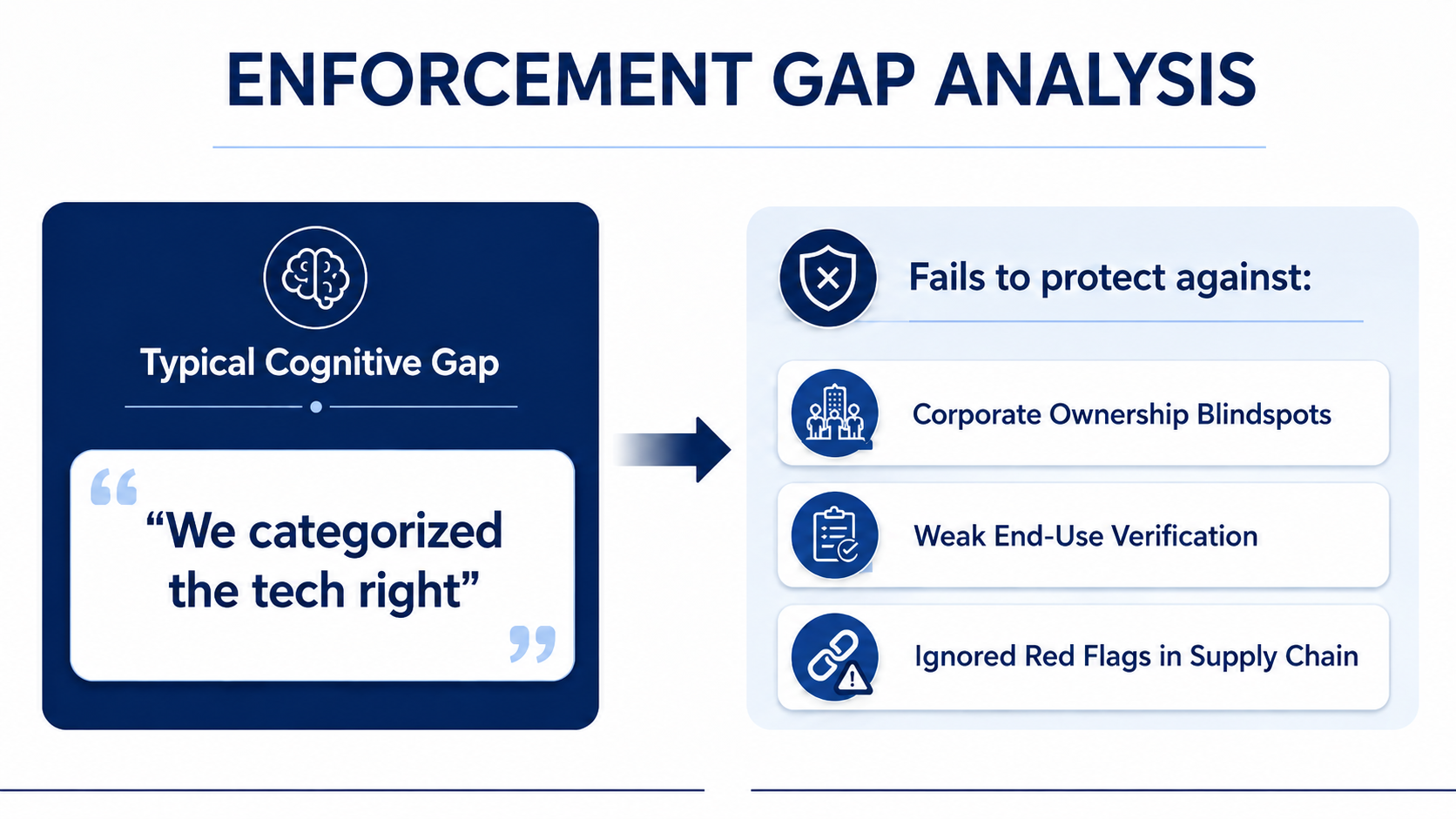
The Reality of Modern Violations: An analysis of recent enforcement actions reveals that organizations are rarely penalized for complex technical classification mistakes. Instead, they are caught by fundamental process breakdowns: ignoring obvious transshipment red flags, failing to trace beneficial ownership, or neglecting downstream end-use documentation.
What this means for your program:
- Transition to an Investigative Stance: Build compliance files defensively, preparing each transaction as if it will face an independent federal audit.
- Audit against real failure patterns, not a generic checklist. Ownership gaps, weak end-use diligence, and diversion blind spots are where the cases live.
- Engage the Board: Frame export compliance as an enterprise financial risk, ensuring executive leadership understands liability thresholds before regulatory intervention occurs.
In the current enforcement paradigm, the most secure organizations are those that proactively identify and mitigate internal process gaps first. Align your compliance program with current federal audit standards.
Key Points
What does the $252 million penalty and 23% enforcement budget increase signal about the enforcement environment organizations must now design compliance programs to operate within?
These two data points together define an enforcement environment that is qualitatively different from the one most compliance programs were designed for — and the program design implications of that shift are more significant than any single regulatory rule change:
- Penalty scale establishing that advanced technology export violations carry financial consequences that are material to organizational balance sheets rather than manageable compliance department costs — A $252 million penalty is not a regulatory fine that compliance budgets absorb — it is a financial event that affects earnings, capital allocation, investor confidence, and in some cases organizational viability; the scale of this penalty reframes export compliance investment from a cost center calculation to a risk management calculation in which the cost of an adequate compliance program is evaluated against the financial exposure that inadequate programs create, a calculation that consistently justifies substantially larger compliance investment than most technology organizations have historically made.
- 23% enforcement budget increase creating a materially higher probability of violation detection that organizations accustomed to low enforcement visibility must factor into their compliance risk calculations — Enforcement budgets determine detection probability as directly as violation frequency determines violation exposure; an organization whose compliance risk calculation was built around historical enforcement intensity must recalibrate against a 23% budget expansion that increases investigative capacity, expands the transaction population subject to review, and signals an institutional commitment to advanced technology enforcement that prior budget levels did not represent; the detection probability increase that enforcement budget expansion creates makes the expected cost of non-compliance substantially higher than historical enforcement patterns suggested.
- Semiconductor and advanced computing designation of the enforcement budget increase signaling that the technology categories most subject to jurisdictional complexity and diversion risk are the ones receiving the most concentrated enforcement attention — The specificity of the budget increase — designated for semiconductor and advanced computing monitoring rather than general export enforcement — identifies the compliance programs that face the most direct enforcement pressure; organizations in these technology categories cannot treat the budget increase as a general industry signal — it is a direct signal to their compliance programs that the enforcement resources being deployed are specifically calibrated to the violations their technology presents.
- Investigative posture replacing administrative review as the enforcement standard requiring compliance programs to be designed against the scrutiny of a federal investigation rather than a routine compliance check — An enforcement posture backed by expanded budget and focused on specific technology categories is investigative rather than administrative — it involves active case development, transaction tracing, ownership investigation, and evidence assembly that goes substantially beyond the document review that routine compliance inspections involve; compliance programs designed to satisfy administrative review will not withstand investigative scrutiny, and the enforcement environment now being resourced is investigative.
- Board and executive engagement becoming a compliance program design requirement rather than a governance best practice in an environment where penalty exposure reaches balance-sheet materiality — When individual enforcement actions reach $252 million, the liability threshold has crossed from compliance department risk into enterprise financial risk that boards have a governance obligation to understand and oversee; compliance programs that operate without board-level visibility into liability thresholds, enforcement trends, and program adequacy assessments are leaving executive leadership without the information needed to fulfill their governance obligations in an enforcement environment where the financial consequences of inadequate oversight are now demonstrably material.
Why do fundamental process breakdowns rather than technical classification errors drive major enforcement outcomes, and what does this pattern reveal about where compliance investment produces the most enforcement protection?
The enforcement pattern — penalties flowing from process failures rather than classification complexity — is one of the most practically significant findings for compliance program design, because it identifies where the compliance gaps that produce major penalties actually live:
- Transshipment red flag failures representing the process breakdown most commonly associated with major enforcement outcomes because they involve ignoring visible warning signs rather than making good-faith analytical errors — Enforcement actions driven by transshipment red flag failures do not involve organizations that conducted diligent due diligence and reached incorrect conclusions — they involve organizations that encountered obvious warning signs and proceeded without investigation; this distinction matters because red flag failures are not addressable through better regulatory knowledge but through better process design — specifically, through escalation procedures that convert red flag identification into mandatory investigation rather than optional enhanced review.
- Beneficial ownership tracing gaps producing enforcement exposure that grows with every transaction involving an undetected restricted party affiliate rather than remaining fixed at the level of the initial screening failure — Beneficial ownership failures compound like jurisdictional misclassification — each transaction with an undetected restricted party affiliate is a separate violation, and the enforcement exposure from ownership investigation gaps scales with transaction volume rather than violation count; organizations that have not implemented the ownership tracing capability the BIS Affiliates Rule and current enforcement expectations require are accumulating per-transaction exposure across their full counterparty population that grows with every transaction that proceeds without adequate ownership verification.
- End-use documentation deficiencies leaving organizations without the evidentiary record needed to demonstrate compliance in an enforcement context where proving where products go and what they enable is the central investigative question — Enforcement investigations focused on diversion and unauthorized end use examine where products actually went and what they actually enabled — questions that inadequate end-use documentation cannot answer; organizations whose end-use records consist of initial customer declarations without verification, monitoring, or lifecycle documentation cannot demonstrate the ongoing compliance posture that enforcement review requires; the documentation gap is not merely an administrative deficiency — it is an evidentiary failure that leaves the organization unable to defend transactions whose compliance depended on end-use controls that were not documented.
- Process breakdown pattern revealing that the compliance investment with the highest enforcement protection return is in operational procedure quality rather than regulatory knowledge depth — If major penalties flow from ignoring red flags, failing to trace ownership, and neglecting end-use documentation rather than from technical classification errors, the compliance investment that most directly reduces enforcement exposure is in the operational procedures that prevent these specific failures — screening escalation protocols, ownership investigation workflows, end-use monitoring programs, and documentation standards — rather than in regulatory knowledge programs that address the classification complexity that enforcement is not primarily targeting.
- Audit design implication requiring that internal compliance audits test against the real failure patterns that enforcement actions identify rather than against the procedural completeness that generic checklists assess — A compliance audit that confirms procedures are documented, training was completed, and screening systems are in place does not test whether the program would have prevented the process failures that produced recent major penalties; effective auditing in the current enforcement environment requires testing specifically against the failure patterns that enforcement actions have identified — simulating the ownership investigation, end-use documentation, and transshipment red flag scenarios that have driven major cases to assess whether the program's operational execution would have detected and prevented them.
What does transitioning to an investigative compliance stance require operationally, and how should organizations build compliance files to withstand federal audit scrutiny?
Building compliance files defensively — as if each transaction will face independent federal audit — requires a documentation standard and file construction methodology that most compliance programs have not previously needed to maintain:
- Transaction file architecture designed to reconstruct the full compliance decision-making process for any transaction from the file alone without requiring recollection from personnel who may no longer be available — A compliance file that withstands federal audit scrutiny must enable an independent reviewer to understand what compliance analysis was conducted, what information was available at the time, what decisions were made and by whom, and why those decisions were consistent with applicable requirements — all from the file itself without requiring supplemental explanation; files that capture outcomes without capturing the analytical process that produced them cannot demonstrate compliance in an investigative context where the adequacy of the decision-making process is as important as the correctness of the outcome.
- Contemporaneous documentation discipline requiring that compliance records are created at the time of the compliance event rather than reconstructed in response to audit notification — Contemporaneous records have evidentiary credibility that reconstructed records lack; a screening result captured at the time of the screen, an end-use verification conducted and documented at the time of verification, and an ownership investigation recorded as it was conducted provide an authentic evidentiary record whose timing demonstrates that compliance review preceded the transaction rather than following audit notification; organizations that reconstruct compliance documentation in response to audit inquiry are providing records whose post-hoc creation is itself an indicator of compliance program inadequacy.
- Ownership investigation files capturing the methodology, data sources, ownership chain traced, aggregate calculation performed, and compliance conclusion reached for every counterparty whose ownership presented investigation triggers — Ownership investigation records that document only the conclusion — no restricted party connection identified — without capturing the methodology and sources that supported the conclusion cannot demonstrate that the investigation was adequate to detect the ownership connections that the investigation was designed to find; files must capture enough analytical detail that an independent reviewer can assess whether the methodology was capable of detecting the restricted party affiliations that the BIS Affiliates Rule and current enforcement expectations require organizations to identify.
- End-use documentation lifecycle extending from pre-transaction due diligence through post-delivery verification in a file structure that demonstrates ongoing compliance monitoring rather than only point-of-sale authorization — End-use documentation that consists only of pre-transaction customer declarations without post-delivery verification records presents a compliance file whose coverage ends at the point where enforcement's investigative interest begins; files must demonstrate ongoing end-use monitoring through periodic verification records, deployment confirmation documentation, and in some cases physical verification evidence that collectively demonstrate the lifecycle compliance posture that the current enforcement focus on where products go and what they enable requires.
- Escalation records demonstrating that identified red flags received genuine compliance review rather than pro forma clearance — Compliance files for transactions where red flags were identified must include escalation records that demonstrate the red flag generated substantive compliance review — capturing what concern was identified, what investigation was conducted, what additional information was obtained, and what reasoning supported the decision to proceed or decline; files where red flags are noted without corresponding investigation records signal the process breakdown pattern that enforcement actions have consistently identified as the compliance failure mode driving major penalties.
How should organizations frame export compliance as enterprise financial risk for board and executive leadership, and what does effective board engagement require?
Board engagement with export compliance requires translation from regulatory compliance language into financial risk language that executive leadership can evaluate alongside other enterprise risks — and the current enforcement environment provides the specific financial terms that make this translation most effective:
- Penalty exposure quantification providing board-level visibility into the maximum financial liability the organization's current compliance program leaves open rather than presenting compliance as a binary compliant or non-compliant assessment — Boards evaluate financial risks in quantified terms; presenting export compliance as a financial risk requires quantifying the penalty exposure that specific compliance gaps create — translating the per-transaction penalty structure, the transaction volume potentially affected by identified gaps, and the current enforcement penalty scale into maximum liability figures that boards can compare against other balance-sheet risks; a board that understands that identified ownership investigation gaps expose the organization to per-transaction penalties across its full advanced technology customer base is making a resource allocation decision with financial terms, not a compliance investment decision with regulatory terms.
- Detection probability communication conveying that the 23% enforcement budget increase specifically targeting semiconductor and advanced computing has materially changed the likelihood that existing compliance gaps will be discovered — Risk assessment requires both consequence magnitude and probability; communicating to boards that the enforcement budget expansion has materially increased detection probability — not merely that enforcement penalties are severe — provides the probability dimension that completes the financial risk calculation; boards that understand both the potential penalty magnitude and the increased detection probability that enforcement budget expansion represents are positioned to make compliance investment decisions that reflect the actual expected cost of non-compliance.
- Competitive and reputational consequence framing extending the financial risk picture beyond direct penalties to include the commercial consequences of enforcement actions that affect customer relationships, government contracting eligibility, and capital market access — A $252 million penalty is the most visible financial consequence of an enforcement action but not the only one; enforcement actions that become public — through press releases, debarment proceedings, or consent agreement requirements — affect customer confidence, government contracting eligibility, banking relationships, and in some cases security clearance standing in ways whose financial consequences can exceed the direct penalty; board-level risk framing must capture these second-order financial consequences alongside the direct penalty to present the full financial risk picture that compliance investment is designed to mitigate.
- Compliance investment ROI framing comparing the cost of proactive compliance program enhancement against the expected financial cost of the violations that enhancement prevents — Executive leadership that evaluates compliance investment as a cost without corresponding risk reduction quantification will systematically underinvest relative to the financial exposure that inadequate programs create; framing compliance investment as risk reduction with quantified return — the cost of a proactive compliance assessment against the expected financial exposure of the process gaps it identifies and closes — provides the investment evaluation framework that produces compliance resource allocation decisions commensurate with current enforcement financial exposure.
- CTP compliance assessment as the board-level risk management action that converts general compliance concern into specific gap identification and remediation planning — Boards that are aware of enforcement risk but lack specific information about their organization's compliance gap profile cannot make resource allocation decisions with the specificity that effective risk management requires; engaging CTP's compliance assessment program converts the general awareness that enforcement risk has increased into specific identification of the process gaps — ownership investigation, end-use documentation, transshipment red flag protocols — that the current enforcement environment is actively targeting, providing the specific risk information that board-level resource allocation decisions require.
What does a compliance program assessment calibrated to current federal audit standards require, and how should organizations prioritize remediation when assessment findings identify multiple process gaps?
Assessment against current federal audit standards — rather than generic compliance checklists — requires specific testing methodology and finding prioritization frameworks that most internal audit programs have not been designed to provide:
- Real failure pattern testing methodology simulating the specific process breakdown scenarios that recent enforcement actions have identified rather than confirming procedural documentation completeness — Assessment methodology calibrated to current enforcement must test whether the compliance program would have detected and prevented the specific process failures that have driven major penalties — not whether documented procedures address applicable regulatory requirements in the abstract; this requires assessment scenarios that simulate transshipment red flag situations, beneficial ownership investigation triggers, and end-use documentation gaps against the program's actual operational responses rather than its documented intended responses.
- Ownership investigation capability assessment testing whether the program can actually detect restricted party affiliations through ownership chains rather than confirming that beneficial ownership is mentioned in compliance policy — Ownership investigation capability assessment must test the program's actual detection capability against simulated ownership scenarios — including multi-tier holding company structures, aggregate ownership combinations involving multiple listed entities, and opaque jurisdictional structures — to determine whether the program's ownership investigation methodology would identify the restricted party connections that the BIS Affiliates Rule and current enforcement expectations require; policy documentation that references beneficial ownership investigation without operational capability to conduct it provides no enforcement protection.
- End-use documentation lifecycle assessment evaluating whether transaction files demonstrate ongoing compliance monitoring or only point-of-sale authorization across a sample of completed transactions — End-use documentation assessment must sample completed transaction files and evaluate whether each file contains the lifecycle documentation — delivery verification, deployment confirmation, periodic monitoring records — that demonstrates ongoing compliance rather than only the pre-transaction authorization documentation that routine compliance processing produces; the gap between documented end-use monitoring procedures and actual end-use documentation in completed transaction files is the assessment finding that most directly predicts enforcement vulnerability in the current investigative environment.
- Finding prioritization framework based on enforcement exposure concentration rather than procedural severity — Assessment findings must be prioritized based on which gaps create the most concentrated enforcement exposure in the current environment — ownership investigation gaps affecting high-volume advanced technology customer relationships, end-use documentation deficiencies for transactions routed through transshipment hubs, and transshipment red flag protocol failures for the specific logistics patterns that current enforcement is targeting — rather than on generic severity classifications that do not reflect current enforcement priority patterns.
- Remediation planning specificity connecting each finding to defined operational changes with ownership, timeline, and verification requirements rather than producing finding reports without implementation pathways — Assessment value is realized through remediation rather than finding identification; each assessment finding must connect to a specific operational change — a revised screening workflow, an enhanced documentation standard, a new ownership investigation protocol — with defined ownership, implementation timeline, and verification mechanism that produces the compliance program improvement the finding indicates is required; assessment reports that identify gaps without defining remediation pathways leave organizations with compliance intelligence they cannot act on within the compressed timelines that current enforcement intensity makes urgent.