Understanding the Difference Between TAAs and MLAs Under ITAR

Article Summary
A TAA authorizes the transfer of defense services or technical data to foreign entities but does not permit manufacturing.
An MLA allows foreign entities to manufacture defense articles using U.S.-origin technical data under ITAR regulations.
TAAs cover assistance like training or technical support, while MLAs authorize manufacturing and production abroad.
Both agreements require submission to DDTC, detailing parties, scope, and activities, and must be approved before implementation.
Obligations include recordkeeping, annual reporting, security measures, and proper termination procedures.
Properly distinguishing between assistance and manufacturing ensures compliance with ITAR and avoids severe penalties.
Introduction
Under the International Traffic in Arms Regulations (ITAR), U.S. companies that export defense articles, technical data, or defense services must obtain authorization from the U.S. Department of State’s Directorate of Defense Trade Controls (DDTC). When a transaction involves sharing technical know-how or working with foreign partners, simple export licenses are often insufficient. Instead, ITAR requires formal written agreements — most commonly, B'Technical Assistance Agreements (TAAs)' and Manufacturing License Agreements (MLAs).
While both serve as mechanisms to authorize transfers of controlled defense technology or services to foreign parties, they have distinct purposes. Understanding the difference between a TAA and an MLA is critical for ensuring compliance and avoiding severe export violations.
Key Details About TAAs and MLAs
1. Technical Assistance Agreements (TAAs)
A Technical Assistance Agreement (TAA) authorizes a U.S. company to B'provide defense services or technical data' to a foreign person or entity.
TAAs are required when the foreign recipient will receive assistance related to the design, development, engineering, or use of a defense article listed on the U.S. Munitions List (USML), but where manufacturing or production is not authorized.
Examples of activities requiring a TAA include:
- Providing technical drawings or blueprints to a foreign partner for integration or maintenance purposes.
- Training foreign engineers or technicians on the operation or repair of U.S.-origin defense systems.
- Sharing controlled technical information to support system upgrades or testing.
In short, TAAs allow know-how and expertise' to be shared, but they B'do not permit manufacturing of the defense article abroad.
2. Manufacturing License Agreements (MLAs)
A Manufacturing License Agreement (MLA) goes a step further. It authorizes a foreign entity not only to receive technical data but also to manufacture defense articles covered by the ITAR.
MLAs are required when a U.S. company intends to allow a foreign partner to:
- Produce or assemble defense articles abroad using U.S.-origin technology.
- Incorporate controlled U.S. components into defense systems manufactured overseas.
- Transfer manufacturing know-how, tooling, or production techniques.
MLAs typically include detailed terms regarding production rights, quality control, retransfer limits, and export authorization for the manufactured items. They are therefore more complex and sensitive than TAAs and undergo heightened DDTC scrutiny.
3. Key Differences Between TAAs and MLAs
Although both agreements involve the transfer of controlled technical data or services, several major distinctions set them apart:
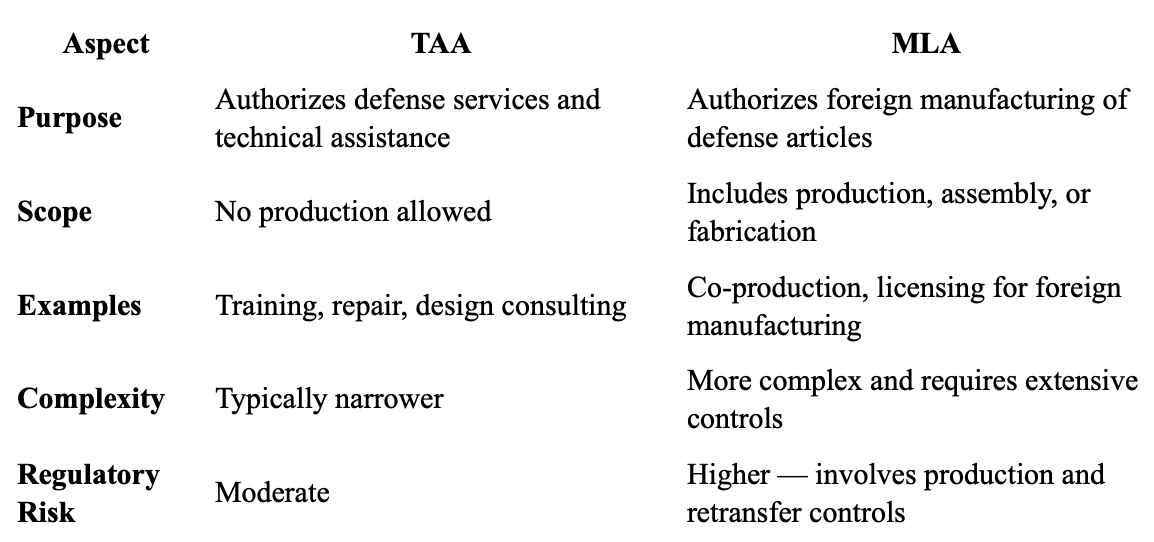
In essence, a TAA covers “assistance,” while an MLA covers “manufacturing.”
4. DDTC Approval Process
Both TAAs and MLAs must be submitted to DDTC under ITAR Part 124 and approved before any controlled data or services are shared.
The process involves:
- Drafting the agreement using DDTC’s required structure and clauses.
- Identifying all U.S. and foreign parties involved.
- Describing the scope of technical data or manufacturing activities.
- Submitting the application through the Defense Export Control and Compliance System (DECCS) portal.
Once approved, the agreement becomes legally binding. Any modifications, extensions, or additional parties must be submitted as amendments and approved by DDTC prior to implementation.
5. Compliance and Ongoing Obligations
Companies with approved TAAs or MLAs must maintain rigorous compliance controls throughout the life of the agreement. This includes:
- Recordkeeping: Keeping detailed logs of all transfers and communications.
- Annual reporting: Submitting reports to DDTC on the status of activities.
- Security measures: Ensuring only authorized individuals access controlled data.
- Termination procedures: Returning or properly disposing of ITAR-controlled data at the end of the agreement.
Violations — even inadvertent — can result in severe civil fines, debarment, or criminal penalties.
Conclusion
While both TAAs and MLAs are essential tools for enabling lawful collaboration with foreign partners under ITAR, the scope and purpose of each differ significantly. TAAs authorize the sharing of defense services or technical data, while MLAs authorize foreign manufacturing based on that data.
Understanding these distinctions ensures that U.S. companies can engage internationally without breaching export control laws. By carefully determining whether an activity involves assistance or production, exporters can select the correct authorization path, maintain compliance, and uphold the integrity of U.S. national security interests.
Key Points
What is a Technical Assistance Agreement (TAA)?
A Technical Assistance Agreement (TAA) is an ITAR authorization that allows U.S. companies to provide defense services or technical data to foreign entities. Key features include:
- Scope: Covers activities like training, design assistance, and technical support.
- Purpose: Enables the sharing of know-how without permitting manufacturing.
- Examples:
- Providing technical drawings or blueprints for maintenance purposes.
- Training foreign engineers on the operation of U.S.-origin defense systems.
- Supporting system upgrades or testing with controlled technical data.
TAAs are essential for ensuring that technical data is shared only with authorized parties and for approved purposes.
What is a Manufacturing License Agreement (MLA)?
A Manufacturing License Agreement (MLA) is an ITAR authorization that allows foreign entities to manufacture defense articles using U.S.-origin technical data. Key features include:
- Scope: Authorizes production, assembly, or incorporation of U.S. components into defense systems abroad.
- Purpose: Facilitates international manufacturing partnerships while maintaining ITAR compliance.
- Examples:
- Allowing a foreign partner to produce defense articles using U.S. technology.
- Transferring manufacturing know-how, tooling, or production techniques.
- Authorizing retransfer limits and export of manufactured items.
MLAs are more complex than TAAs and undergo heightened scrutiny by DDTC due to their sensitive nature.
What are the key differences between TAAs and MLAs?
While both agreements involve the transfer of controlled technical data or services, the primary distinctions are:
- Purpose:
- TAAs cover assistance, such as training or technical support.
- MLAs authorize manufacturing and production abroad.
- Scope:
- TAAs do not permit manufacturing.
- MLAs include production rights and manufacturing know-how.
- Complexity:
- MLAs are more detailed and require stricter compliance measures.
In essence, TAAs focus on “assistance,” while MLAs focus on “manufacturing”.
What is the DDTC approval process for TAAs and MLAs?
Both TAAs and MLAs must be submitted to the Directorate of Defense Trade Controls (DDTC) for approval before any controlled data or services are shared. The process includes:
- Drafting the agreement: Using DDTC’s required structure and clauses.
- Identifying parties: Listing all U.S. and foreign entities involved.
- Describing scope: Detailing the technical data or manufacturing activities.
- Submitting via DECCS: Using the Defense Export Control and Compliance System portal.
Once approved, the agreement becomes legally binding. Amendments or extensions must also be submitted and approved by DDTC.
What compliance obligations apply to TAAs and MLAs?
Companies with approved TAAs or MLAs must adhere to strict compliance measures, including:
- Recordkeeping: Maintaining logs of all transfers and communications.
- Annual reporting: Submitting updates to DDTC on the status of activities.
- Security measures: Ensuring only authorized individuals access controlled data.
- Termination procedures: Returning or disposing of ITAR-controlled data at the end of the agreement.
Violations can result in severe penalties, including fines, debarment, or criminal charges.
Why is understanding the difference between TAAs and MLAs important?
Properly distinguishing between TAAs and MLAs ensures compliance with ITAR and avoids costly violations. Key reasons include:
- Regulatory alignment: Ensures the correct authorization is used for the intended activity.
- Risk mitigation: Reduces the likelihood of penalties or export violations.
- National security: Upholds the integrity of U.S. export controls and foreign policy objectives.
By understanding these distinctions, exporters can engage internationally while maintaining compliance and protecting U.S. national security interests.